It’s June 13th, day four of my Arts Tasmania supported residency here in Tassie. I’ve written two Dutch/Multilingual songs in my first three days here - ‘Almost Kiwi’ and ‘Kibbeling’ - and I set myself the goal of writing a third song.
When I wrote the song ‘Kibbeling’ on day two and three of my residency, I had tossed up whether the song should feature kibbeling or tompoucen:
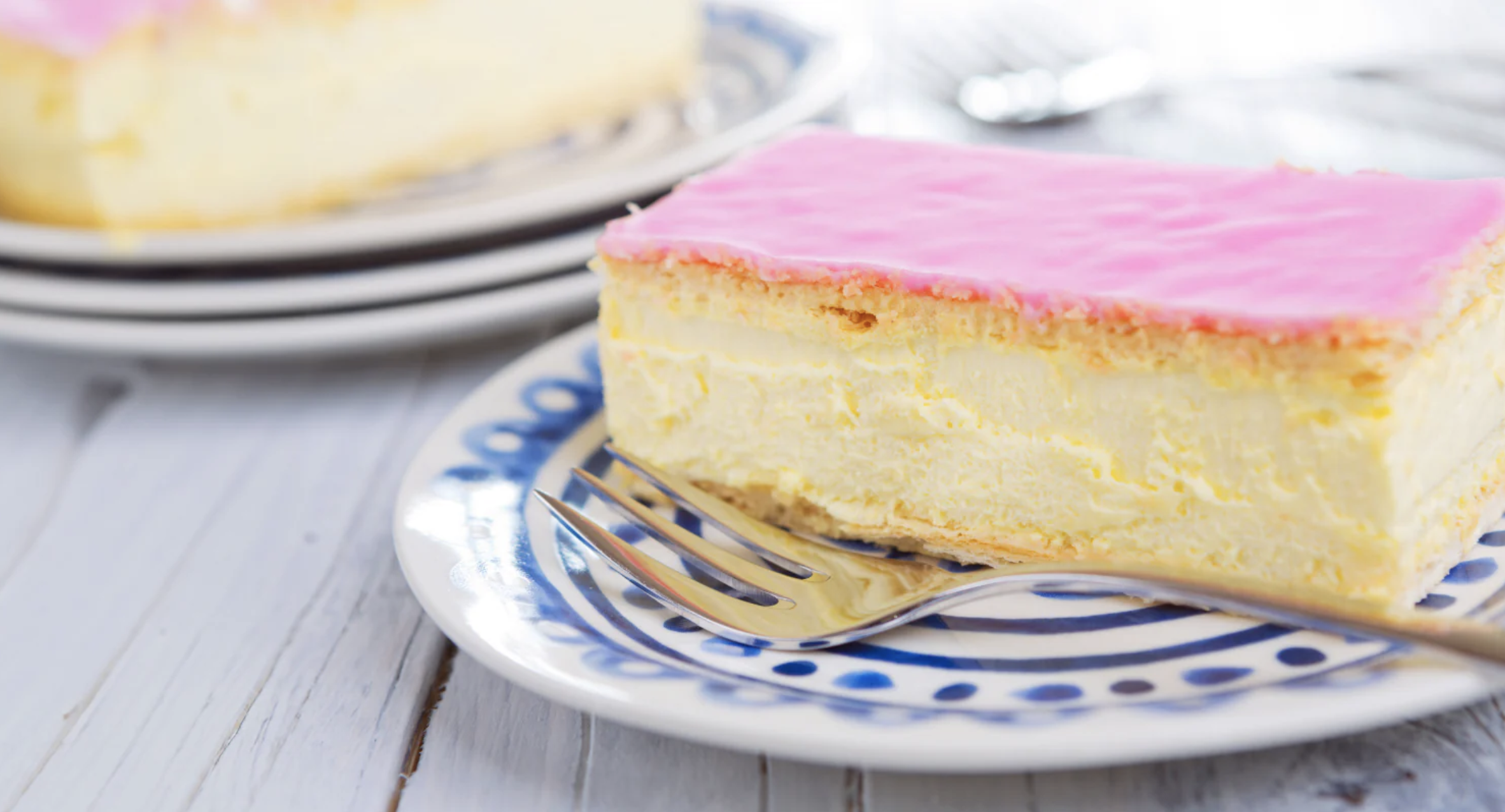
Kibbeling is a Dutch snack of deep-fried fish (usually cod), bought at the markets. Tompoucen are the Dutch version of the French mille-feuille. In the Netherlands, you buy tompoucen at the banketbakkerij, iced white or pink, unless there’s a national celebration, when they are decorated with orange icing (anyone who ever watches international soccer will know that orange is our Dutch colour).
When I was little I used to make tompoucen at home, from a packet that provided the pastry and only required you to mix up the custard and ice the pastries. It was something that as an eight-year-old I could do unsupervised and it was probably my first experience of the joy of baking for my family. So there’s a sweet nostalgia to tompoucen, and having gone with kibbeling in the previous song, I decide that they deserve a song of their own.
I want this to be a lighthearted song, or better still, a humorous song. Writing about deep, philosophical, raw, profound, vulnerable, heart-wrenching topics is as easy for me as pouring myself a morning coffee, but now I’m on a mission to write a funny song, and one that includes tompoucen.
Like last time, I start with a chord progression. I’m in 6/8. It feels a little cabaret. I can almost hear the accordion…
To me, a chord progression is like an open question, asking for a melody. Embedded in its rhythmic articulation is an implied lyrical cadence. I’m really just finding lyrics that want to be there, and that sit comfortably, like they belong.
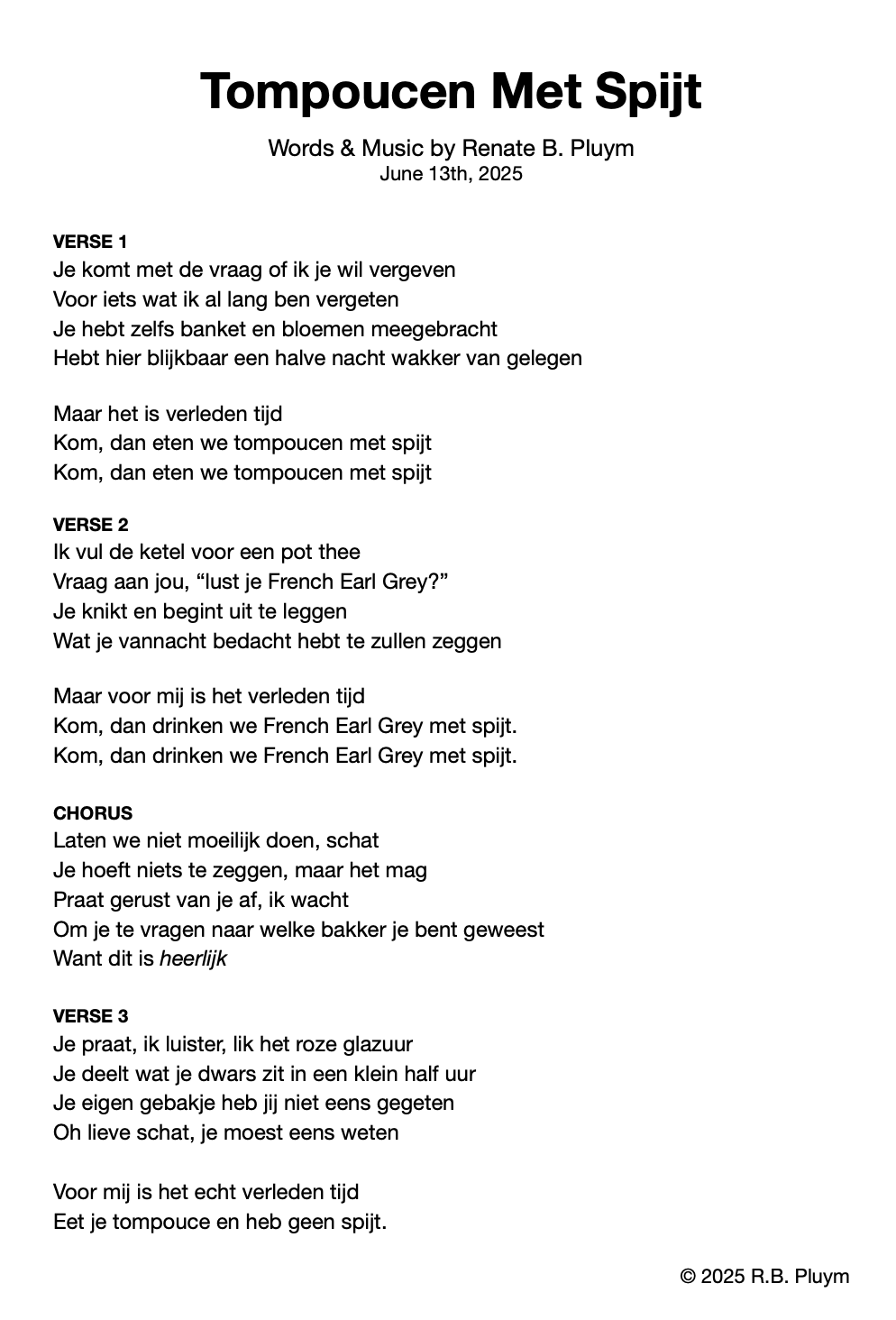
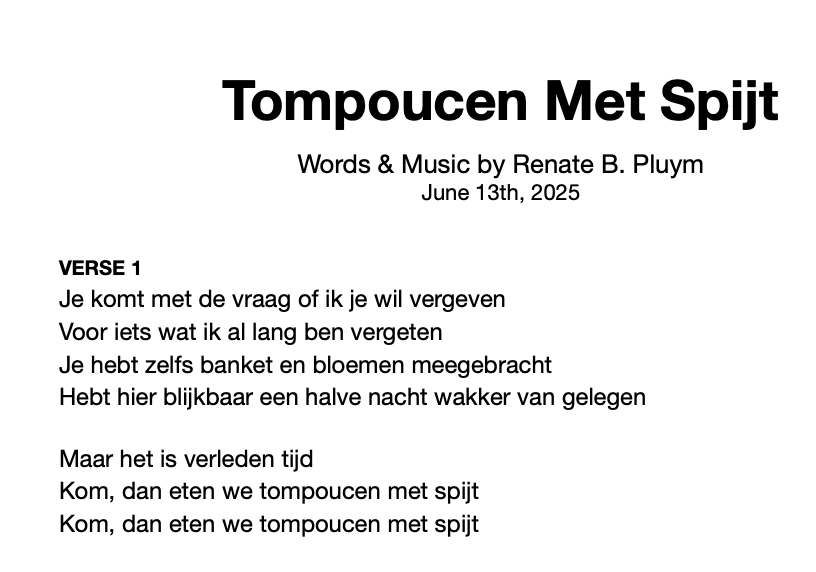
“Je komt met de vraag of ik je wil vergeven,
Voor iets wat ik al lang ben vergeten”
You turn up asking if I would be willing to forgive you
For something that I have long forgotten
Oh, it occurs to me, they feel terrible, but the other person is totally chill. They’ve been lying awake over this, wrecked with guilt, coming to apologise with tompoucen... oh, and flowers of course... but the other person is like, “all good, no worries”
The other person responds:
“Kom, dan eten we tompoucen met spijt”
Come, we’ll eat tompoucen with regret
In the second verse the other person fills the kettle for a pot of tea, which I decide should be my favourite tea, French Earl Grey, which is the perfect accompaniment to these millefeuille-inspired pastries. The second verse ends with a variant of that earlier line:
“Kom, dan drinken we French Earl Grey met spijt”
Come, we’ll drink French Earl Grey with regret
As I write the song, I find myself wondering about the backstory. Who is the person apologising? What is their relationship with the other person? What are they sorry for? How is it that one character has moved on from something that another character loses sleep over? What is the dramatic plot?
I decide that the song doesn’t need a complete backstory. It doesn't need any of these questions to be answered for it to work, because what is interesting is what is happening right under our noses. The song is about the apology, how it is going down and how this reflects on the current relationship between these two people. I leave the rest open, so that the listener can use their imagination to fill in these narrative details for themselves.
For comedic value, I deliberately overstate that the person apologising does it to alleviate their own guilt more than anything else and that the person receiving the apology has moved on to such a degree that they’re more focussed on the pastries than what the other person is trying to get off their chest.
It’s a light-hearted, almost Aussie, “all good, mate, let’s just eat these pastries”, which I decide is funny enough.
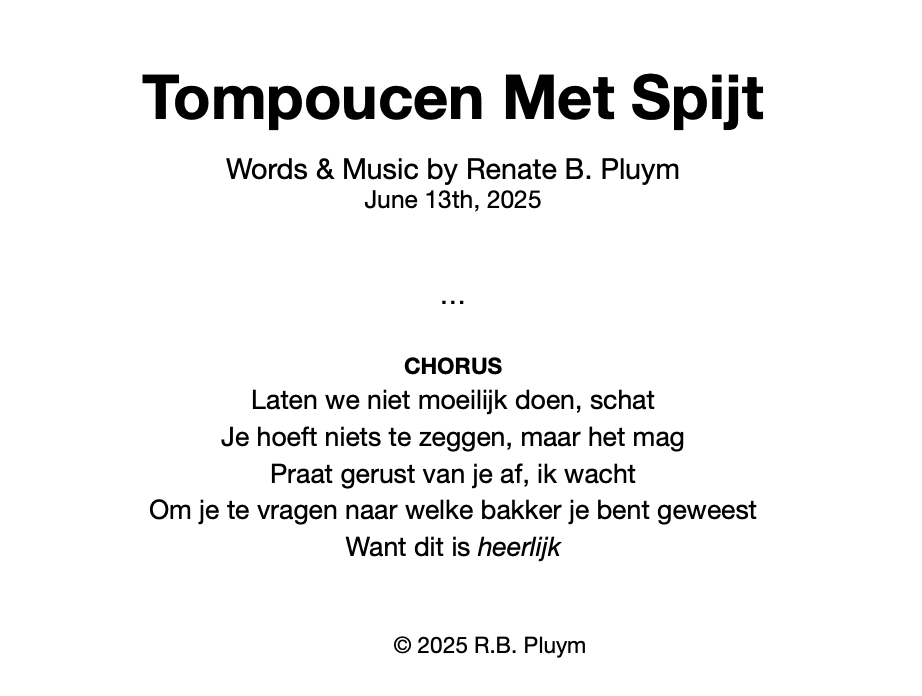
The chorus takes that one step further:
Let’s not make this difficult, love.
You don’t need to say anything, although you can.
Get it off your chest, if you want. I’ll wait...
To ask you which bakery you went to
‘Cause this is delicious
In verse three the person apologising has been talking for half an hour, their tompouce entirely untouched, while the other person is casually licking the pink icing off their pastry. Having heard them out, this person cuts to the chase, ending the song with the suggestion to simply:
“Eet je tompouce en heb geen spijt”
Eat your tompouce and don’t have any regrets
Renaté
June 13th, 2025
Arts Tasmania supported Residency
Poatina, Tasmania
© 2025 R.B. Pluym